
2007年AIME I 真题:
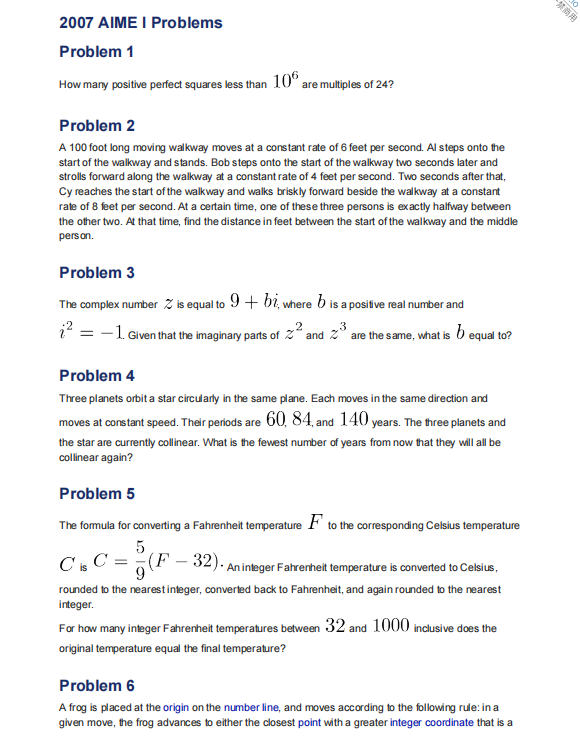
Problem 1
How many positive perfect squares less than  are multiples of 24?
Problem 2
A 100 foot long moving walkway moves at a constant rate of 6 feet per second. Al steps onto the start of the walkway and stands. Bob steps onto the start of the walkway two seconds later and strolls forward along the walkway at a constant rate of 4 feet per second. Two seconds after that, Cy reaches the start of the walkway and walks briskly forward beside the walkway at a constant rate of 8 feet per second. At a certain time, one of these three persons is exactly halfway between the other two. At that time, find the distance in feet between the start of the walkway and the middle person.
Problem 3
The complex number  is equal to
  , where
  is a positive real number and
  . Given that the imaginary parts of
  and
and  are the same, what is equal to?
Problem 4
Three planets orbit a star circularly in the same plane. Each moves in the same direction and moves at constant speed. Their periods are  ,
,  , and
, and  years. The three planets and the star are currently collinear. What is the fewest number of years from now that they will all be collinear again?
Problem 5
The formula for converting a Fahrenheit temperature  to the corresponding Celsius temperature
  is
is  An integer Fahrenheit temperature is converted to Celsius, rounded to the nearest integer, converted back to Fahrenheit, and again rounded to the nearest integer.
For how many integer Fahrenheit temperatures between  and
and  inclusive does the original temperature equal the final temperature?
Problem 6
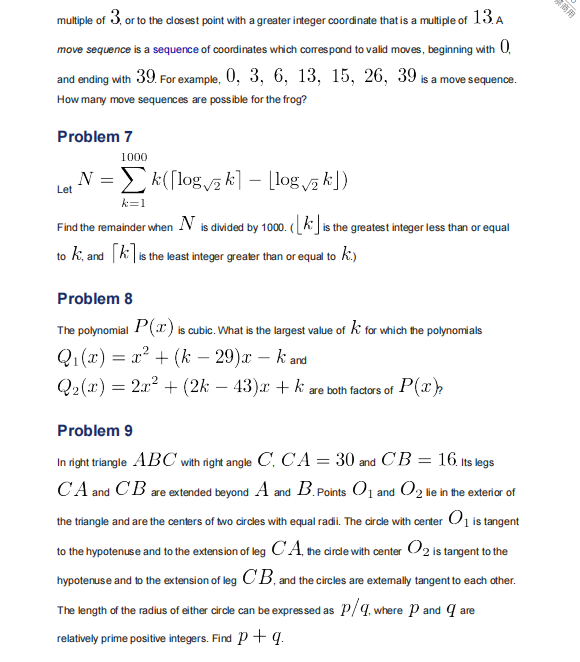
A frog is placed at the origin on the number line, and moves according to the following rule: in a given move, the frog advances to either the closest point with a greater integer coordinate that is a multiple of  , or to the closest point with a greater integer coordinate that is a multiple of
  . A move sequence is a sequence of coordinates which correspond to valid moves, beginning with
  , and ending with
  . For example,
  is a move sequence. How many move sequences are possible for the frog?
Problem 7
Let 
Find the remainder when  is divided by 1000. (
 is the greatest integer less than or equal to
  , and
, and  is the least integer greater than or equal to .)
Problem 8
The polynomial  is cubic. What is the largest value of for which the polynomials
  and
and  are both factors of ?
Problem 9
In right triangle  with right angle ,
  and
and  . Its legs
  and
and  are extended beyond
  and
and  . Points
  and
and  lie in the exterior of the triangle and are the centers of two circles with equal radii. The circle with center is tangent to the hypotenuse and to the extension of leg , the circle with center is tangent to the hypotenuse and to the extension of leg , and the circles are externally tangent to each other. The length of the radius of either circle can be expressed as
  , where
  and
and  are relatively prime positive integers. Find
  .
.
以下是我们为您整理的真题试卷:

更多AIME 历年真题+真题详解
扫码添加顾问即可免费领取