
2006年AIME I 真题:
Problem 1
In quadrilateral  is a right angle, diagonal
  is perpendicular to
  and
and  Find the perimeter of
Problem 2
Let set  be a 90-element subset of
  and let
  be the sum of the elements of
  Find the number of possible values of
Problem 3
Find the least positive integer such that when its leftmost digit is deleted, the resulting integer is  of the original integer.
Problem 4
Let  be the number of consecutive 0's at the right end of the decimal representation of the product
  Find the remainder when is divided by 1000.
Problem 5
The number  can be written as
  where
where  and
and  are positive integers. Find
Problem 6
Let  be the set of real numbers that can be represented as repeating decimals of the form
  where
where  are distinct digits. Find the sum of the elements of
Problem 7
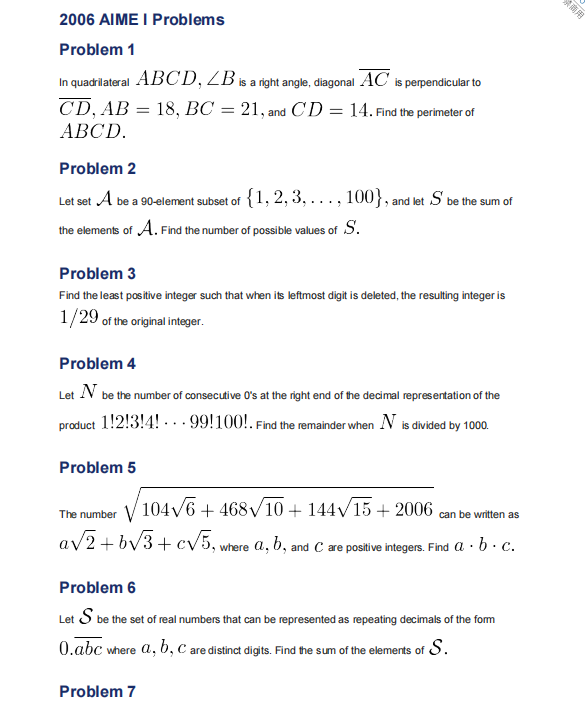
An angle is drawn on a set of equally spaced parallel lines as shown. The ratio of the area of shaded region  to the area of shaded region
  is
is  . Find the ratio of shaded region
  to the area of shaded region
  .
.
![[asy] size(6cm); defaultpen(linewidth(0.7)+fontsize(10)); for(int i=0; i<4; i=i+1) { fill((2*i,0)--(2*i+1,0)--(2*i+1,6)--(2*i,6)--cycle, mediumgray); } pair A=(1/3,4), B=A+7.5*dir(-17), C=A+7*dir(10); draw(B--A--C); fill((7.3,0)--(7.8,0)--(7.8,6)--(7.3,6)--cycle, white); clip(B--A--C--cycle); for(int i=0; i<9; i=i+1) { draw((i,1)--(i,6)); } label("$\mathcal{A}$", A+0.2*dir(-17), S); label("$\mathcal{B}$", A+2.3*dir(-17), S); label("$\mathcal{C}$", A+4.4*dir(-17), S); label("$\mathcal{D}$", A+6.5*dir(-17), S); [/asy]](https://latex.artofproblemsolving.com/1/9/8/1985e47141f84873a1d3fffdb0d43fb205c5f8d8.png)
Problem 8
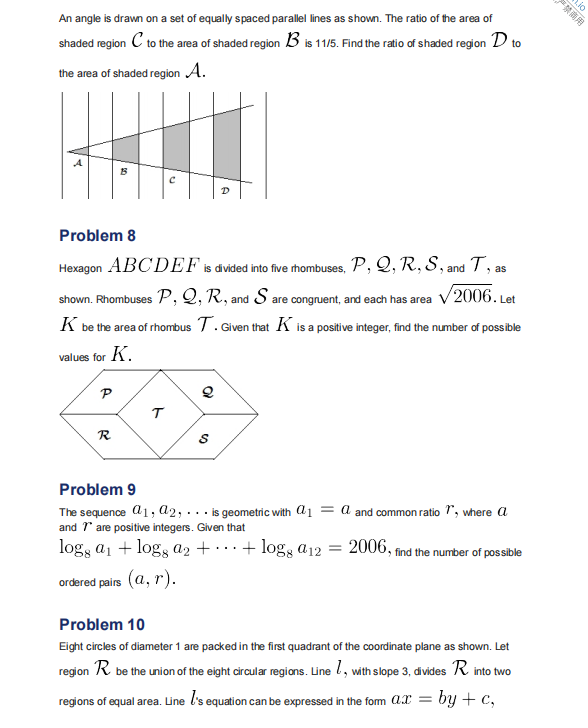
Hexagon  is divided into five rhombuses,
  and
and  , as shown. Rhombuses
  and are congruent, and each has area
  Let
Let  be the area of rhombus . Given that is a positive integer, find the number of possible values for
![[asy] // TheMathGuyd size(8cm); pair A=(0,0), B=(4.2,0), C=(5.85,-1.6), D=(4.2,-3.2), EE=(0,-3.2), F=(-1.65,-1.6), G=(0.45,-1.6), H=(3.75,-1.6), I=(2.1,0), J=(2.1,-3.2), K=(2.1,-1.6); draw(A--B--C--D--EE--F--cycle); draw(F--G--(2.1,0)); draw(C--H--(2.1,0)); draw(G--(2.1,-3.2)); draw(H--(2.1,-3.2)); label("$\mathcal{T}$",(2.1,-1.6)); label("$\mathcal{P}$",(0,-1),NE); label("$\mathcal{Q}$",(4.2,-1),NW); label("$\mathcal{R}$",(0,-2.2),SE); label("$\mathcal{S}$",(4.2,-2.2),SW); [/asy]](https://latex.artofproblemsolving.com/6/a/0/6a063c7eb18cc2a02ebddd2f3216e2c02cb09c89.png)
Problem 9
The sequence  is geometric with
  and common ratio
  where
where  and
and  are positive integers. Given that
  find the number of possible ordered pairs
以下是我们为您整理的真题试卷,扫码领取完整版:

更多AIME 历年真题+真题详解
扫码添加顾问即可免费领取