
2004年AIME I 真题:
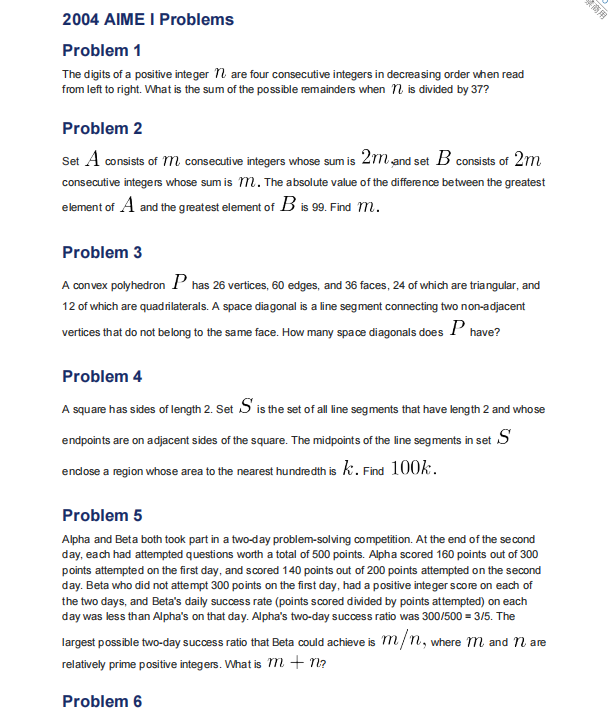
Problem 1
The digits of a positive integer  are four consecutive integers in decreasing order when read from left to right. What is the sum of the possible remainders when is divided by 37?
Problem 2
Set  consists of
  consecutive integers whose sum is
  and set
  consists of
  consecutive integers whose sum is
  The absolute value of the difference between the greatest element of and the greatest element of is 99. Find
Problem 3
A convex polyhedron  has 26 vertices, 60 edges, and 36 faces, 24 of which are triangular, and 12 of which are quadrilaterals. A space diagonal is a line segment connecting two non-adjacent vertices that do not belong to the same face. How many space diagonals does have?
Problem 4
A square has sides of length 2. Set  is the set of all line segments that have length 2 and whose endpoints are on adjacent sides of the square. The midpoints of the line segments in set enclose a region whose area to the nearest hundredth is
  Find
Find 
Problem 5
Alpha and Beta both took part in a two-day problem-solving competition. At the end of the second day, each had attempted questions worth a total of  points. Alpha scored
  points out of
  points attempted on the first day, and scored
  points out of
  points attempted on the second day. Beta who did not attempt points on the first day, had a positive integer score on each of the two days, and Beta's daily success rate (points scored divided by points attempted) on each day was less than Alpha's on that day. Alpha's two-day success ratio was
  . The largest possible two-day success ratio that Beta could achieve is
  where and are relatively prime positive integers. What is
  ?
?
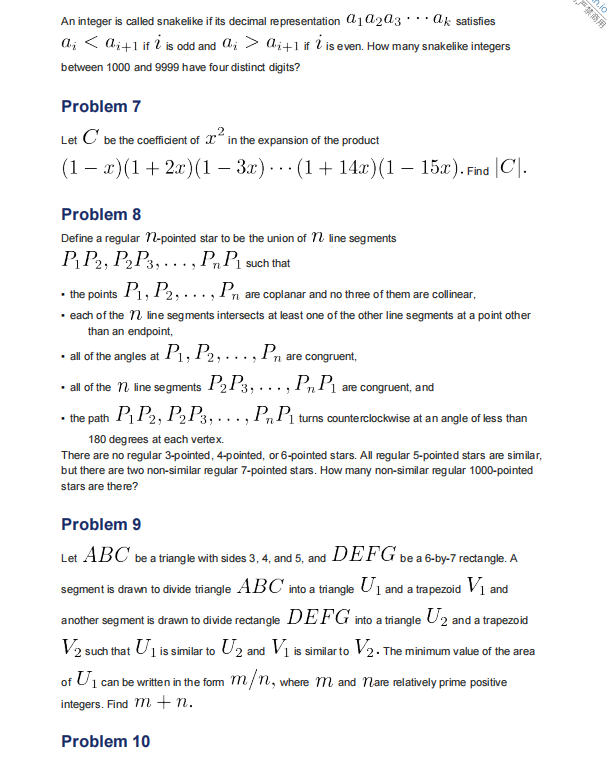
Problem 6
An integer is called snakelike if its decimal representation  satisfies
  if
if  is odd and
  if is even. How many snakelike integers between 1000 and 9999 have four distinct digits?
Problem 7
Let  be the coefficient of
  in the expansion of the product
  Find
Find 
Problem 8
Define a regular -pointed star to be the union of line segments  such that
the points  are coplanar and no three of them are collinear,
each of the line segments intersects at least one of the other line segments at a point other than an endpoint,
all of the angles at are congruent,
all of the line segments are congruent, and
the path turns counterclockwise at an angle of less than 180 degrees at each vertex.
There are no regular 3-pointed, 4-pointed, or 6-pointed stars. All regular 5-pointed stars are similar, but there are two non-similar regular 7-pointed stars. How many non-similar regular 1000-pointed stars are there?
以下是我们为您整理的真题试卷,扫码领取完整版:

更多AIME 历年真题+真题详解
扫码添加顾问即可免费领取