与AMC10/12相比,AIME竞赛难度显著提升,题型更为复杂,对参赛者的数学技巧与逻辑思维要求严苛。为助力考生精准评估自身实力并高效备赛,我们整理了AIME历年真题及详细解析的高清电子版,方便打印与深度练习,助你直击核心,攻克难关。
2026 AIME II卷真题及答案
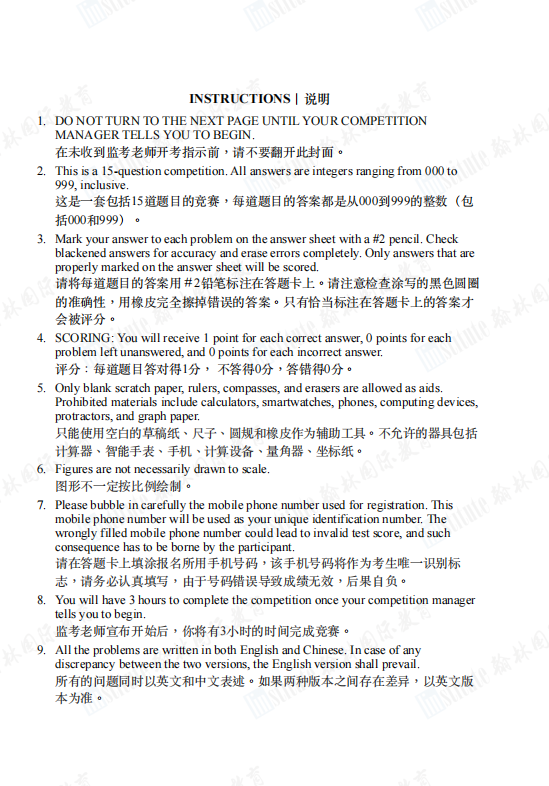
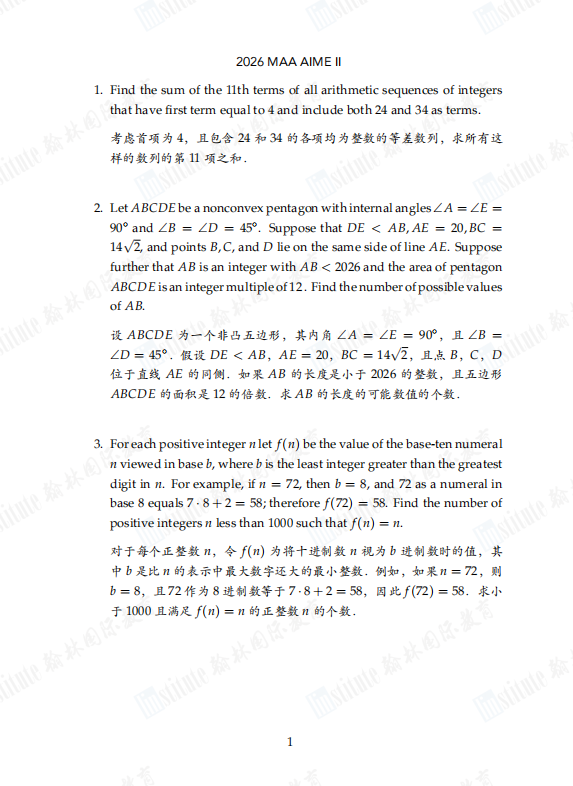
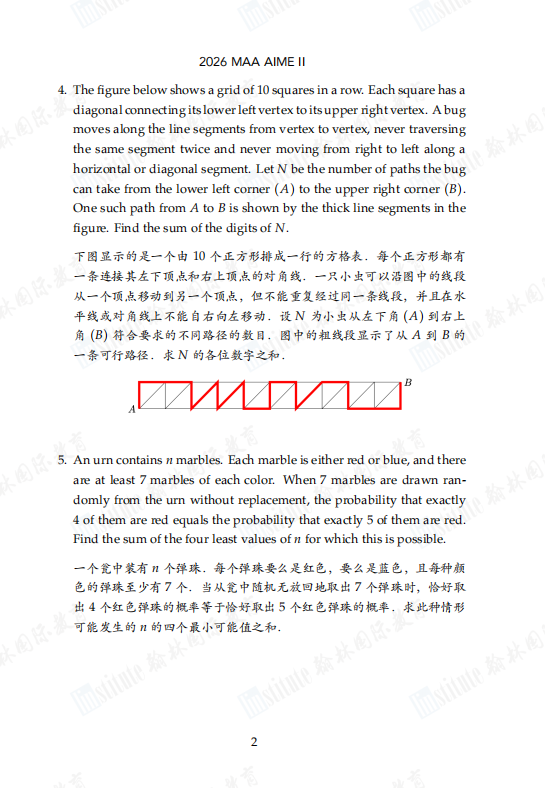
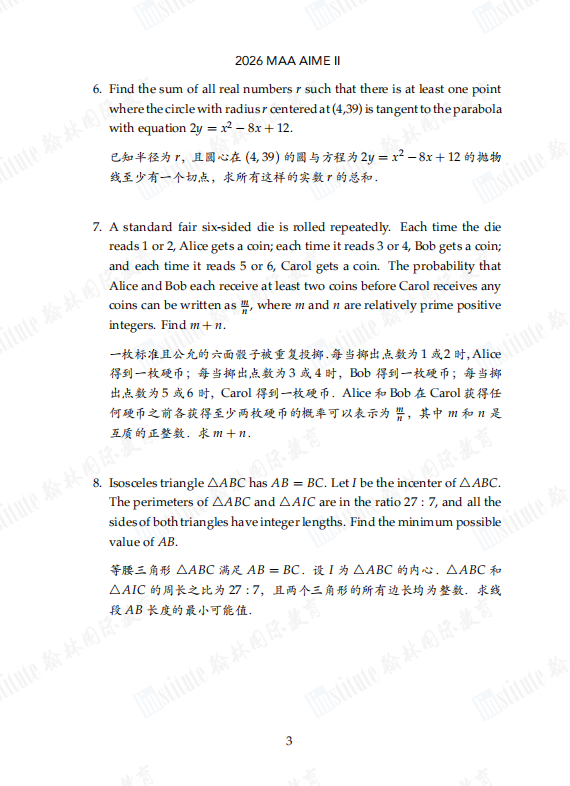
以上仅展示2026年AIME II 部分真题,完整版扫描文末二维码即可免费领取,还有更多AIME历年真题+解析~


更多AIME 备赛资料包+历年真题+真题详解
扫码添加顾问即可免费领取

与AMC10/12相比,AIME竞赛难度显著提升,题型更为复杂,对参赛者的数学技巧与逻辑思维要求严苛。为助力考生精准评估自身实力并高效备赛,我们整理了AIME历年真题及详细解析的高清电子版,方便打印与深度练习,助你直击核心,攻克难关。
2026 AIME II卷真题及答案
以上仅展示2026年AIME II 部分真题,完整版扫描文末二维码即可免费领取,还有更多AIME历年真题+解析~
更多AIME 备赛资料包+历年真题+真题详解
扫码添加顾问即可免费领取
自2025起AIME Ⅰ不再对国际考生开放,国内参赛选手只能报名AIME Ⅱ。但仍然可做练习使用,也可以为备考USA(J)MO后续更高阶数学竞赛做准备。
2026年AIME I 真题
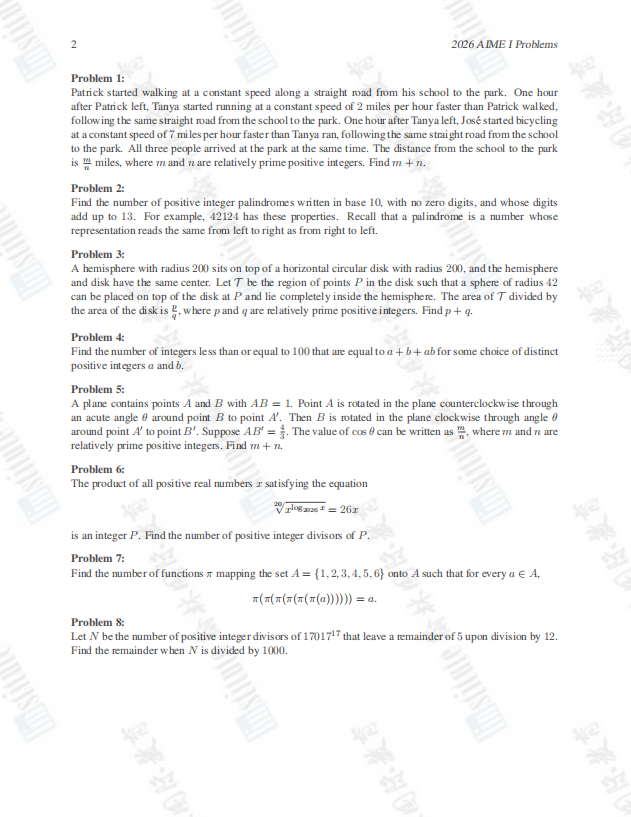
以上仅展示2026年AIME I 部分真题,完整版扫描文末二维码即可免费领取,还有更多AIME历年真题+解析~
更多AIME 备赛资料包+历年真题+真题详解
扫码添加顾问即可免费领取
AMC8作为全球最具影响力的初中数学竞赛之一,不仅是激发数学兴趣的“启蒙赛”,更是小升初择校、国际升学、竞赛进阶的重要敲门砖。其奖项设置科学、权威,尤其全球前1%和前5%的荣誉,被国内顶尖学校和海外教育机构高度认可。
本文全面解析 AMC8奖项评定标准、近年分数线走势、2026年难度变化预判,并精准匹配不同年级、能力与升学需求的学生,助你高效规划备赛路径。
一、AMC8奖项设置与含金量
AMC8奖项分为个人奖和团体奖,其中个人奖对升学价值最大,具体如下:
| 奖项名称 | 英文缩写 | 获奖标准 | 2025年分数线 | 含金量 |
| 满分奖 | Perfect Score | 答对全部25题 | 25分 | 极高,全国仅数十人,顶尖名校“明星简历”标配 |
| 全球卓越奖 | DHR (Distinguished Honor Roll) |
全球前1% | 23分 | ⭐⭐⭐⭐⭐ 申请上海“三公”、北京“六小强”、国际学校核心加分项 |
| 全球优秀奖 | HR (Honor Roll) |
全球前5% | 19分 | ⭐⭐⭐⭐ 小升初/初升高简历亮点,体现扎实数学能力 |
| 全球荣誉奖 | AR (Achievement Roll) |
6年级及以下 + ≥15分 | 15分 | ⭐⭐⭐ 鼓励低年级超前学习,展示早期潜力 |
家长重点关注:
若目标上海三公(上实、上外、浦外)、北京人大附早培等,DHR(前1%)是黄金门槛;
若申请国际学校或美高,HR(前5%)已具备显著竞争力。
二、近5年分数线趋势 & 2026年预判
近年AMC8全球前1%与前5%分数线(满分25):
| 年份 | DHR(前1%) | HR(前5%) |
| 2020 | 21 | 18 |
| 2022 | 22 | 19 |
| 2023 | 21 | 17 |
| 2024 | 22 | 18 |
| 2025 | 23 | 19 |
趋势分析:
分数线整体稳中有升,反映参赛者水平提高;
2025年DHR达23分,为近5年最高,竞争加剧。
2026年特殊变化:题目难度提升!
中国区组委会为保障公平性,改编部分题目,个别题接近AMC10水平;
题目更强调逻辑推理与跨知识点整合,减少纯计算题。
2026年分数线预判:
| 奖项 | 预测分数线 | 依据 |
| DHR(前1%) | 22分左右 | 题目变难,高分人数减少,分数线或小幅下调 |
| HR(前5%) | 18–19分 | 中档题稳定性强,预计与近年持平 |
策略建议:
目标DHR的学生,确保基础题(1–15题)零失误,中档题(16–20题)错≤1题,难题(21–25题)争取对1–2题。
三、AMC8适合哪些学生?三大维度精准匹配
1.按年级划分
| 年级 | 适配性 | 备赛建议 |
| 3–4年级 | 黄金启蒙期 | 若校内数学拔尖(如奥数班前30%),可开始接触AMC8思维题,重在兴趣培养 |
| 5–6年级 | 核心参赛群体 | 系统学习AMC8四大模块(算术、代数、几何、计数),目标HR/DHR |
| 7–8年级 | 冲刺+过渡期 | 冲刺DHR,同时衔接AMC10内容,为AIME晋级铺路 |
特别提醒:
上海“三公”简历投递通常在5年级上学期4月,因此最晚4年级下启动AMC8备考!
2.按能力划分
数学基础扎实:熟练掌握分数、百分比、比例、简单方程、平面几何;
逻辑思维强:能快速识别题目陷阱,构建解题路径(如分类讨论、逆向思维);
有挑战意愿:计划未来参加AMC10/12、AIME,或走数学竞赛路线。
3.按升学需求划分
| 升学目标 | AMC8作用 | 建议目标奖项 |
| 国内小升初(三公、六小强) | 简历核心亮点,部分学校设“AMC8 DHR直通”通道 | DHR(前1%) |
| 国际学校/双语学校初升高 | 证明数学能力与国际接轨 | HR(前5%)及以上 |
| 未来出国读美高/本科 | 积累早期学术竞赛记录 | HR起步,DHR更佳 |
扫码进入AMC8专属学习社群,海量备赛资料&体验课程等你开启!
发送【年级+学校+课程体系】

2027年AMC8备考课程安排
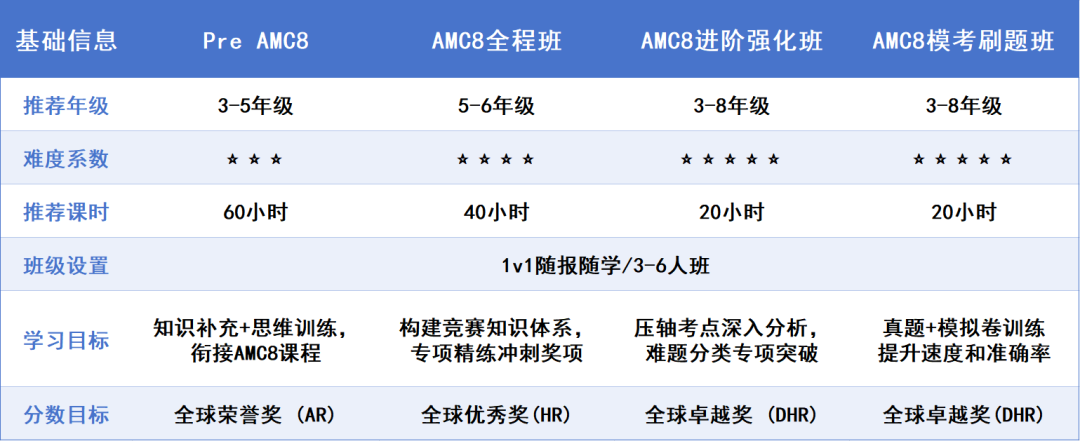
针对于不同基础的同学,制定了系统的备考课程体系,分别为:Pre-AMC8课程、AMC8竞赛全程班、AMC8竞赛进阶强化班和AMC8考前模考班!
不知道是否适合AMC8?
扫码回复【在读年级+AMC8测试题】进行AMC8前测题/专业分析评估
基础较为薄弱的学生——Pre-AMC8课程
基础较为扎实的学生——AMC8竞赛全程班
已具备5%水平的学生——AMC8竞赛进阶强化班
知识完备考前冲刺热身的同学——AMC8考前模考班
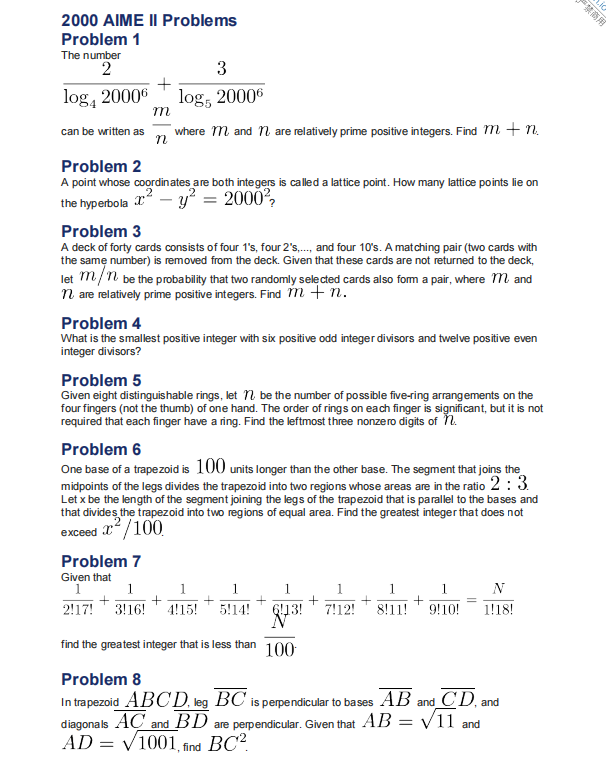
Problem 1
The number

 where
where  and
and  are relatively prime positive integers. Find
  .
.
Problem 2
A point whose coordinates are both integers is called a lattice point. How many lattice points lie on the hyperbola  ?
?
Problem 3
A deck of forty cards consists of four 1's, four 2's,..., and four 10's. A matching pair (two cards with the same number) is removed from the deck. Given that these cards are not returned to the deck, let  be the probability that two randomly selected cards also form a pair, where and are relatively prime positive integers. Find
Problem 4
What is the smallest positive integer with six positive odd integer divisors and twelve positive even integer divisors?
Problem 5
Given eight distinguishable rings, let be the number of possible five-ring arrangements on the four fingers (not the thumb) of one hand. The order of rings on each finger is significant, but it is not required that each finger have a ring. Find the leftmost three nonzero digits of .
Problem 6
One base of a trapezoid is  units longer than the other base. The segment that joins the midpoints of the legs divides the trapezoid into two regions whose areas are in the ratio
  . Let
. Let  be the length of the segment joining the legs of the trapezoid that is parallel to the bases and that divides the trapezoid into two regions of equal area. Find the greatest integer that does not exceed
  .
.
Problem 7
Given that

 .
.
Problem 8
In trapezoid  , leg
, leg  is perpendicular to bases
  and
and  , and diagonals
  and
and  are perpendicular. Given that
  and
and  , find
  .
.
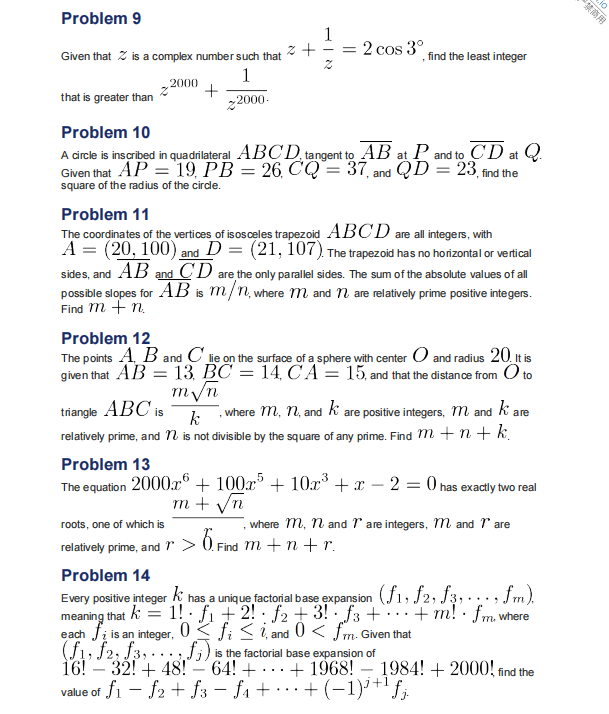
Problem 9
Given that  is a complex number such that
  , find the least integer that is greater than
  .
.
以下是我们为您整理的真题试卷,扫码领取完整版:

更多AIME 历年真题+真题详解
扫码添加顾问即可免费领取

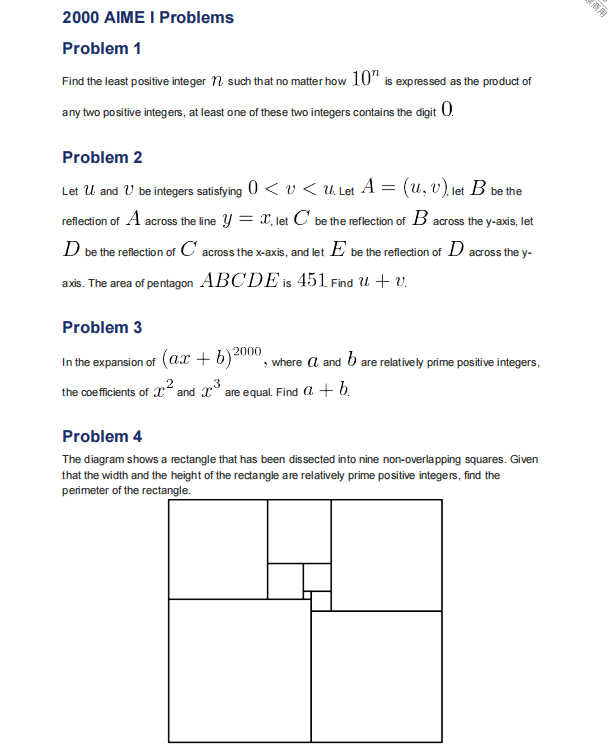
Problem 1
Find the least positive integer such that no matter how  is expressed as the product of any two positive integers, at least one of these two integers contains the digit
  .
.
Problem 2
Let  and
and  be integers satisfying
  . Let
. Let  , let
, let  be the reflection of
  across the line
  , let
, let  be the reflection of across the y-axis, let
  be the reflection of across the x-axis, and let
  be the reflection of across the y-axis. The area of pentagon
  is
is  . Find
  .
.
Problem 3
In the expansion of  where
where  and
and  are relatively prime positive integers, the coefficients of
  and
and  are equal. Find
  .
.
Problem 4
The diagram shows a rectangle that has been dissected into nine non-overlapping squares. Given that the width and the height of the rectangle are relatively prime positive integers, find the perimeter of the rectangle.
![[asy]defaultpen(linewidth(0.7)); draw((0,0)--(69,0)--(69,61)--(0,61)--(0,0));draw((36,0)--(36,36)--(0,36)); draw((36,33)--(69,33));draw((41,33)--(41,61));draw((25,36)--(25,61)); draw((34,36)--(34,45)--(25,45)); draw((36,36)--(36,38)--(34,38)); draw((36,38)--(41,38)); draw((34,45)--(41,45));[/asy]](https://latex.artofproblemsolving.com/b/4/b/b4bba1a273e9631a49fa74039b89e66ad4433573.png)
Problem 5
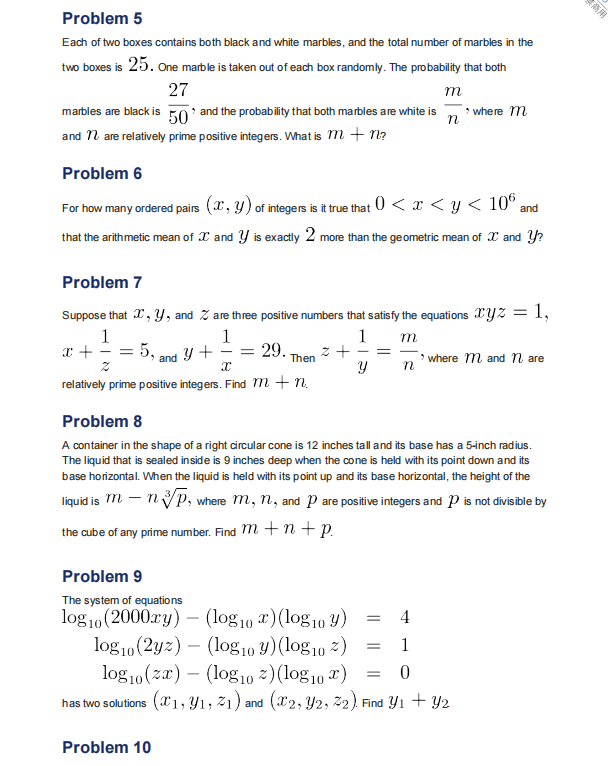
Each of two boxes contains both black and white marbles, and the total number of marbles in the two boxes is  One marble is taken out of each box randomly. The probability that both marbles are black is
  and the probability that both marbles are white is
  where and are relatively prime positive integers. What is ?
Problem 6
For how many ordered pairs  of integers is it true that
  and that the arithmetic mean of and
  is exactly
  more than the geometric mean of and ?
Problem 7
Suppose that 
 and are three positive numbers that satisfy the equations
 and
and  Then
Then  where and are relatively prime positive integers. Find .
Problem 8
A container in the shape of a right circular cone is 12 inches tall and its base has a 5-inch radius. The liquid that is sealed inside is 9 inches deep when the cone is held with its point down and its base horizontal. When the liquid is held with its point up and its base horizontal, the height of the liquid is ![$m - n\sqrt [3]{p},$](https://latex.artofproblemsolving.com/1/5/8/1586f2bca69882cdcb09b653822a61d6a5931db7.png) where
where 
 and
and  are positive integers and is not divisible by the cube of any prime number. Find
  .
.
Problem 9
The system of equations
has two solutions  and
and  . Find
  .
.
以下是我们为您整理的真题试卷,扫码领取完整版:
更多AIME 历年真题+真题详解
扫码添加顾问即可免费领取
Problem 1
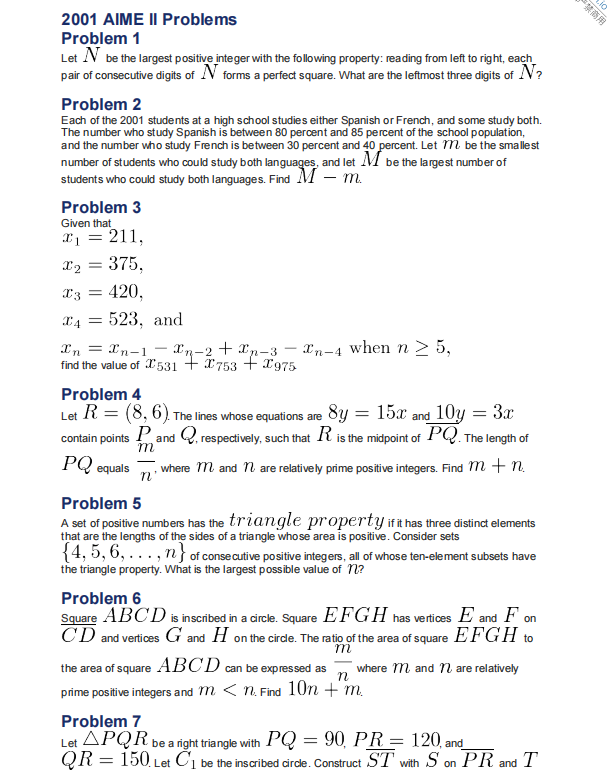
Let  be the largest positive integer with the following property: reading from left to right, each pair of consecutive digits of forms a perfect square. What are the leftmost three digits of ?
Problem 2
Each of the 2001 students at a high school studies either Spanish or French, and some study both. The number who study Spanish is between 80 percent and 85 percent of the school population, and the number who study French is between 30 percent and 40 percent. Let be the smallest number of students who could study both languages, and let  be the largest number of students who could study both languages. Find
  .
.
Problem 3
Given that find the value of
  .
.
Problem 4
Let  . The lines whose equations are
  and
and  contain points
  and
and  , respectively, such that
  is the midpoint of
  . The length of
  equals
  , where and are relatively prime positive integers. Find .
Problem 5
A set of positive numbers has the  if it has three distinct elements that are the lengths of the sides of a triangle whose area is positive. Consider sets
  of consecutive positive integers, all of whose ten-element subsets have the triangle property. What is the largest possible value of ?
Problem 6
Square is inscribed in a circle. Square  has vertices and
  on and vertices
  and
and  on the circle. The ratio of the area of square to the area of square can be expressed as where and are relatively prime positive integers and
  . Find
  .
.
Problem 7
Let  be a right triangle with
  ,
,  , and
, and  . Let
. Let  be the inscribed circle. Construct
  with
with  on
on  and
and  on
on  , such that is perpendicular to and tangent to . Construct
  with
with  on and
  on such that is perpendicular to and tangent to . Let
  be the inscribed circle of
  and
and  the inscribed circle of
  . The distance between the centers of and can be written as
  . What is ?
Problem 8
A certain function  has the properties that
  for all positive real values of , and that
  for
for  . Find the smallest for which
  .
.
Problem 9
Each unit square of a 3-by-3 unit-square grid is to be colored either blue or red. For each square, either color is equally likely to be used. The probability of obtaining a grid that does not have a 2-by-2 red square is , where and are relatively prime positive integers. Find .
以下是我们为您整理的真题试卷,扫码领取完整版:
更多AIME 历年真题+真题详解
扫码添加顾问即可免费领取
Problem 1
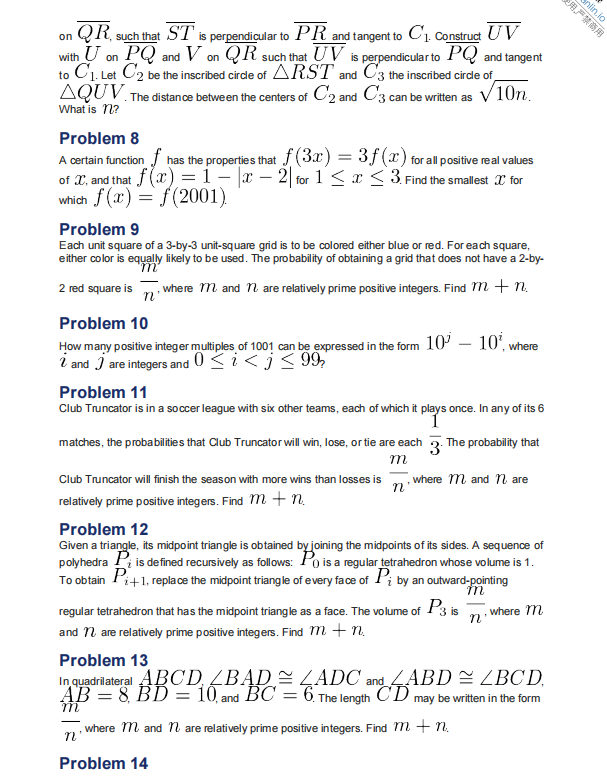
Find the sum of all positive two-digit integers that are divisible by each of their digits.
Problem 2
A finite set  of distinct real numbers has the following properties: the mean of
  is
is  less than the mean of , and the mean of
  is
is  more than the mean of . Find the mean of .
Problem 3
Find the sum of the roots, real and non-real, of the equation  , given that there are no multiple roots.
Problem 4
In triangle  , angles and measure
  degrees and
  degrees, respectively. The bisector of angle intersects at , and
  . The area of triangle can be written in the form
  , where , , and
  are positive integers, and is not divisible by the square of any prime. Find
  .
.
Problem 5
An equilateral triangle is inscribed in the ellipse whose equation is  . One vertex of the triangle is
  , one altitude is contained in the y-axis, and the length of each side is
  , where and are relatively prime positive integers. Find
  .
.
Problem 6
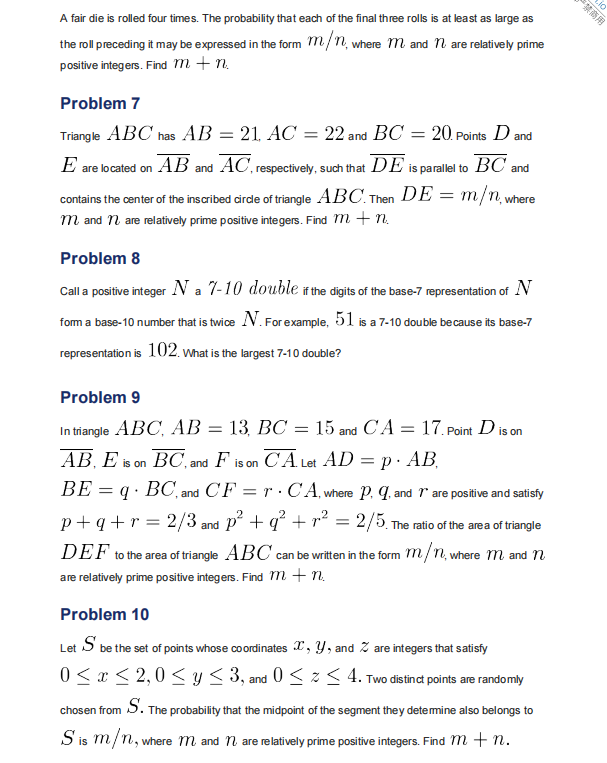
A fair die is rolled four times. The probability that each of the final three rolls is at least as large as the roll preceding it may be expressed in the form , where and are relatively prime positive integers. Find .
Problem 7
Triangle has  ,
,  and
and  . Points and are located on and , respectively, such that
  is parallel to and contains the center of the inscribed circle of triangle . Then
  , where and are relatively prime positive integers. Find .
Problem 8
Call a positive integer a  if the digits of the base-7 representation of form a base-10 number that is twice . For example,
  is a 7-10 double because its base-7 representation is
  . What is the largest 7-10 double?
Problem 9
In triangle ,  ,
,  and
and  . Point is on , is on , and is on
  . Let
. Let  ,
,  , and
, and  , where ,
  , and
, and  are positive and satisfy
  and
and  . The ratio of the area of triangle
  to the area of triangle can be written in the form , where and are relatively prime positive integers. Find .
以下是我们为您整理的真题试卷,扫码领取完整版:
更多AIME 历年真题+真题详解
扫码添加顾问即可免费领取
Problem 1
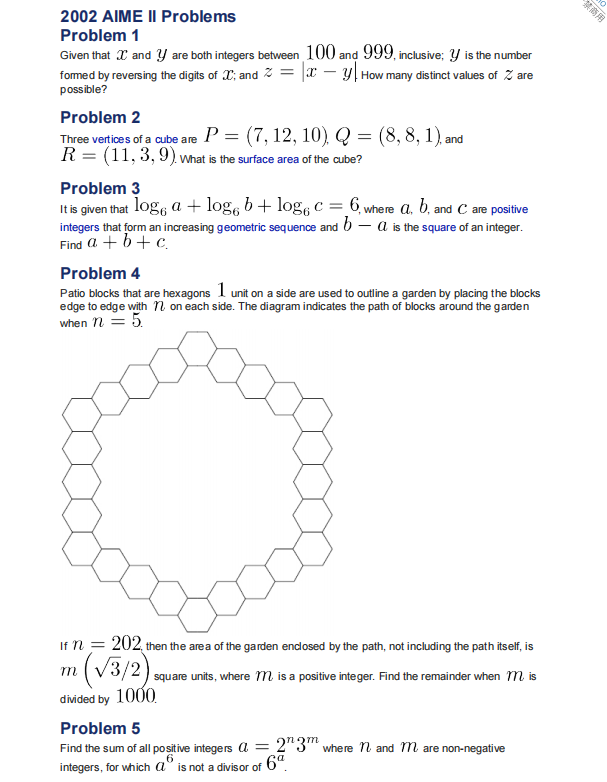
Given that and are both integers between and  , inclusive; is the number formed by reversing the digits of ; and
  . How many distinct values of are possible?
Problem 2
Three vertices of a cube are  ,
,  , and
, and  . What is the surface area of the cube?
Problem 3
It is given that  , where , , and are positive integers that form an increasing geometric sequence and
  is the square of an integer. Find
  .
.
Problem 4
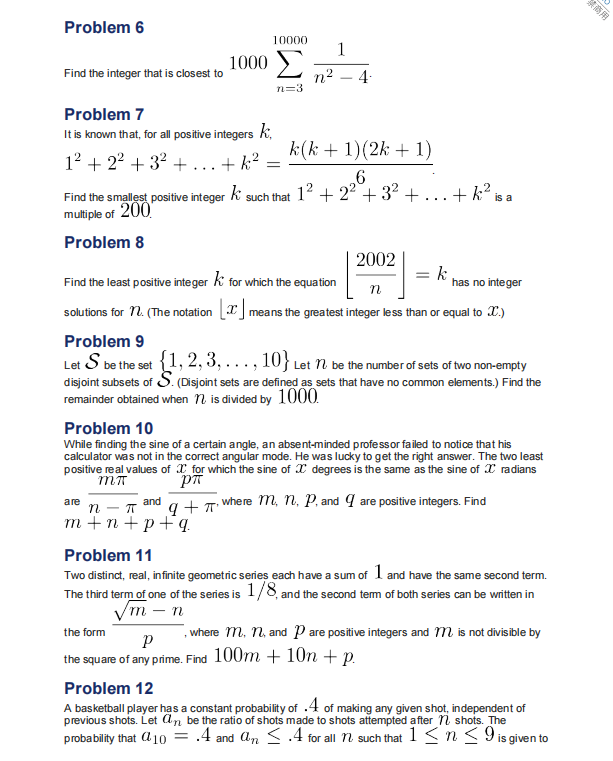
Patio blocks that are hexagons  unit on a side are used to outline a garden by placing the blocks edge to edge with on each side. The diagram indicates the path of blocks around the garden when
  .
.

If  , then the area of the garden enclosed by the path, not including the path itself, is
  square units, where is a positive integer. Find the remainder when is divided by
  .
.
Problem 5
Find the sum of all positive integers  where and are non-negative integers, for which
  is not a divisor of
  .
.
Problem 6
Find the integer that is closest to  .
.
Problem 7
It is known that, for all positive integers  ,
,
 . such that
  is a multiple of
  .
.
Problem 8
Find the least positive integer for which the equation  has no integer solutions for . (The notation
  means the greatest integer less than or equal to .)
Problem 9
Let be the set  . Let be the number of sets of two non-empty disjoint subsets of . (Disjoint sets are defined as sets that have no common elements.) Find the remainder obtained when is divided by .
以下是我们为您整理的真题试卷,扫码领取完整版:
更多AIME 历年真题+真题详解
扫码添加顾问即可免费领取
Problem 1
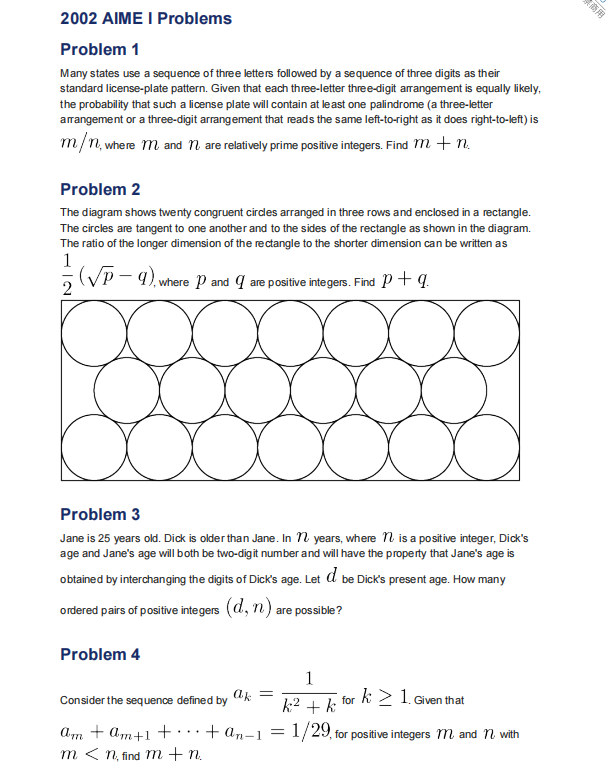
Many states use a sequence of three letters followed by a sequence of three digits as their standard license-plate pattern. Given that each three-letter three-digit arrangement is equally likely, the probability that such a license plate will contain at least one palindrome (a three-letter arrangement or a three-digit arrangement that reads the same left-to-right as it does right-to-left) is , where and are relatively prime positive integers. Find .
Problem 2
The diagram shows twenty congruent circles arranged in three rows and enclosed in a rectangle. The circles are tangent to one another and to the sides of the rectangle as shown in the diagram. The ratio of the longer dimension of the rectangle to the shorter dimension can be written as  , where and are positive integers. Find
  .
.
![[asy] size(250);real x=sqrt(3); int i; draw(origin--(14,0)--(14,2+2x)--(0,2+2x)--cycle); for(i=0; i<7; i=i+1) { draw(Circle((2*i+1,1), 1)^^Circle((2*i+1,1+2x), 1)); } for(i=0; i<6; i=i+1) { draw(Circle((2*i+2,1+x), 1)); } [/asy]](https://latex.artofproblemsolving.com/9/5/4/954424e16552d40041fb782328143ad217cdfdf9.png)
Problem 3
Jane is 25 years old. Dick is older than Jane. In years, where is a positive integer, Dick's age and Jane's age will both be two-digit numbers and will have the property that Jane's age is obtained by interchanging the digits of Dick's age. Let  be Dick's present age. How many ordered pairs of positive integers
  are possible?
Problem 4
Consider the sequence defined by  for
for  . Given that
  , for positive integers and with
  , find .
Problem 5
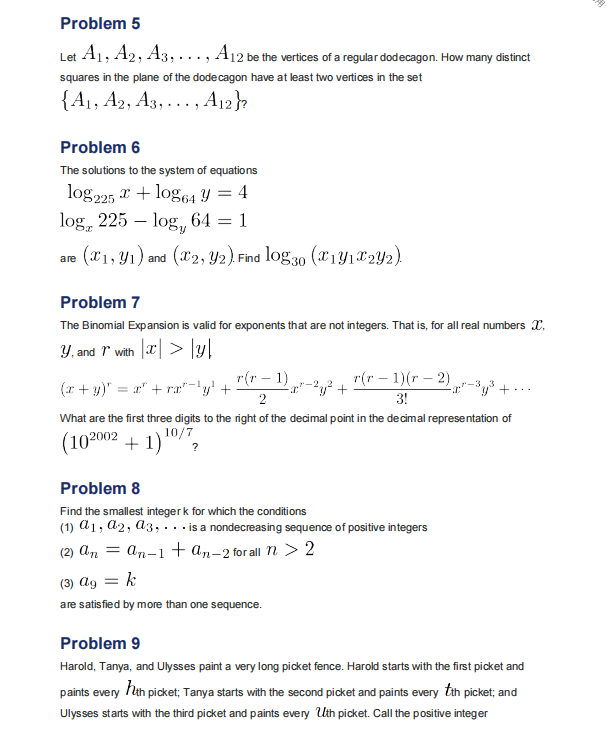
Let  be the vertices of a regular dodecagon. How many distinct squares in the plane of the dodecagon have at least two vertices in the set
  ?
?
Problem 6
The solutions to the system of equations
 are
are  and
and  . Find
  .
.
Problem 7
The Binomial Expansion is valid for exponents that are not integers. That is, for all real numbers , , and with  ,
,

 ?
?
Problem 8
Find the smallest integer for which the conditions
(1)  is a nondecreasing sequence of positive integers
(2)  for all
(3) 
are satisfied by more than one sequence.
Problem 9
Harold, Tanya, and Ulysses paint a very long picket fence. Harold starts with the first picket and paints every  th picket; Tanya starts with the second picket and paints every
  th picket; and Ulysses starts with the third picket and paints every th picket. Call the positive integer
 when the triple
  of positive integers results in every picket being painted exactly once. Find the sum of all the paintable integers.
以下是我们为您整理的真题试卷,扫码领取完整版:
更多AIME 历年真题+真题详解
扫码添加顾问即可免费领取
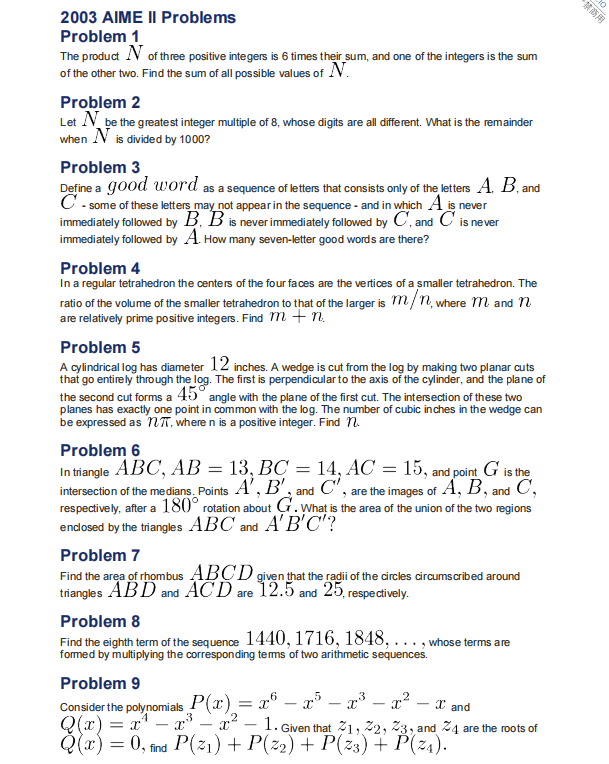
Problem 1
The product of three positive integers is 6 times their sum, and one of the integers is the sum of the other two. Find the sum of all possible values of .
Problem 2
Let be the greatest integer multiple of 8, whose digits are all different. What is the remainder when is divided by 1000?
Problem 3
Define a  as a sequence of letters that consists only of the letters , , and - some of these letters may not appear in the sequence - and in which is never immediately followed by , is never immediately followed by , and is never immediately followed by . How many seven-letter good words are there?
Problem 4
In a regular tetrahedron, the centers of the four faces are the vertices of a smaller tetrahedron. The ratio of the volume of the smaller tetrahedron to that of the larger is , where and are relatively prime positive integers. Find .
Problem 5
A cylindrical log has diameter  inches. A wedge is cut from the log by making two planar cuts that go entirely through the log. The first is perpendicular to the axis of the cylinder, and the plane of the second cut forms a
  angle with the plane of the first cut. The intersection of these two planes has exactly one point in common with the log. The number of cubic inches in the wedge can be expressed as
  , where n is a positive integer. Find .
Problem 6
In triangle 


 and point is the intersection of the medians. Points
 and
and  are the images of
 and
and  respectively, after a
  rotation about
  What is the area of the union of the two regions enclosed by the triangles and
Problem 7
Find the area of rhombus given that the radii of the circles circumscribed around triangles  and
and  are
are  and
and  , respectively.
Problem 8
Find the eighth term of the sequence 

 whose terms are formed by multiplying the corresponding terms of two arithmetic sequences.
Problem 9
Consider the polynomials  and
and  Given that
  and
and  are the roots of
  find
find 
以下是我们为您整理的真题试卷,扫码领取完整版:
更多AIME 历年真题+真题详解
扫码添加顾问即可免费领取