
2003年AIME I 真题:
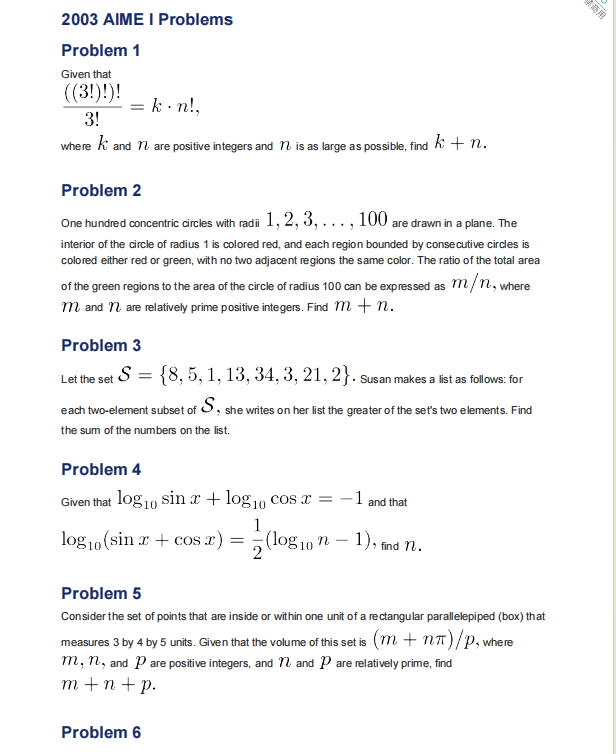
Problem 1
Given that

 and
and  are positive integers and is as large as possible, find
Problem 2
One hundred concentric circles with radii  are drawn in a plane. The interior of the circle of radius 1 is colored red, and each region bounded by consecutive circles is colored either red or green, with no two adjacent regions the same color. The ratio of the total area of the green regions to the area of the circle of radius 100 can be expressed as
  where
where  and are relatively prime positive integers. Find
Problem 3
Let the set  Susan makes a list as follows: for each two-element subset of
  she writes on her list the greater of the set's two elements. Find the sum of the numbers on the list.
Problem 4
Given that  and that
  find
find 
Problem 5
Consider the set of points that are inside or within one unit of a rectangular parallelepiped (box) that measures 3 by 4 by 5 units. Given that the volume of this set is  where
where  and
and  are positive integers, and and are relatively prime, find
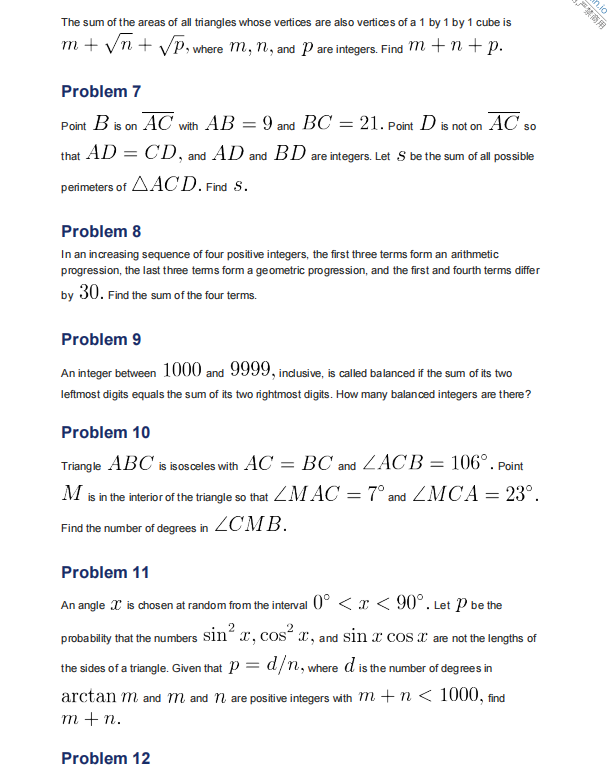
Problem 6
The sum of the areas of all triangles whose vertices are also vertices of a 1 by 1 by 1 cube is  where and are integers. Find
Problem 7
Point  is on
is on  with
with  and
and  Point
Point  is not on so that
  and
and  and
and  are integers. Let
  be the sum of all possible perimeters of
  Find
Find 
Problem 8
In an increasing sequence of four positive integers, the first three terms form an arithmetic progression, the last three terms form a geometric progression, and the first and fourth terms differ by  Find the sum of the four terms.
Problem 9
An integer between  and
and  inclusive, is called balanced if the sum of its two leftmost digits equals the sum of its two rightmost digits. How many balanced integers are there?
以下是我们为您整理的真题试卷,扫码领取完整版:

更多AIME 历年真题+真题详解
扫码添加顾问即可免费领取