
2003年AIME II 真题:
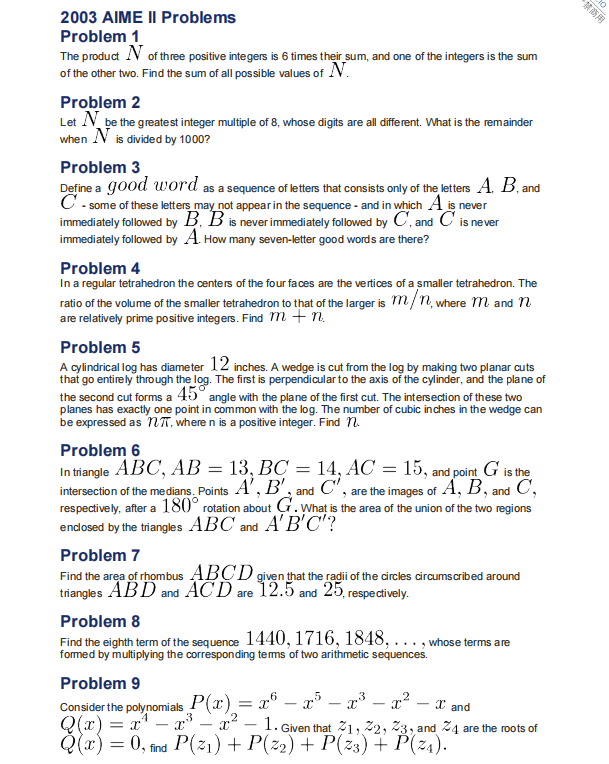
Problem 1
The product  of three positive integers is 6 times their sum, and one of the integers is the sum of the other two. Find the sum of all possible values of .
Problem 2
Let be the greatest integer multiple of 8, whose digits are all different. What is the remainder when is divided by 1000?
Problem 3
Define a  as a sequence of letters that consists only of the letters
  ,
,  , and
, and  - some of these letters may not appear in the sequence - and in which is never immediately followed by , is never immediately followed by , and is never immediately followed by . How many seven-letter good words are there?
Problem 4
In a regular tetrahedron, the centers of the four faces are the vertices of a smaller tetrahedron. The ratio of the volume of the smaller tetrahedron to that of the larger is  , where
  and
and  are relatively prime positive integers. Find
  .
.
Problem 5
A cylindrical log has diameter  inches. A wedge is cut from the log by making two planar cuts that go entirely through the log. The first is perpendicular to the axis of the cylinder, and the plane of the second cut forms a
  angle with the plane of the first cut. The intersection of these two planes has exactly one point in common with the log. The number of cubic inches in the wedge can be expressed as
  , where n is a positive integer. Find .
Problem 6
In triangle 


 and point
  is the intersection of the medians. Points
 and
and  are the images of
 and
and  respectively, after a
  rotation about
  What is the area of the union of the two regions enclosed by the triangles
  and
and 
Problem 7
Find the area of rhombus  given that the radii of the circles circumscribed around triangles
  and
and  are
are  and
and  , respectively.
Problem 8
Find the eighth term of the sequence 

 whose terms are formed by multiplying the corresponding terms of two arithmetic sequences.
Problem 9
Consider the polynomials  and
and  Given that
  and
and  are the roots of
  find
find 
以下是我们为您整理的真题试卷,扫码领取完整版:

更多AIME 历年真题+真题详解
扫码添加顾问即可免费领取